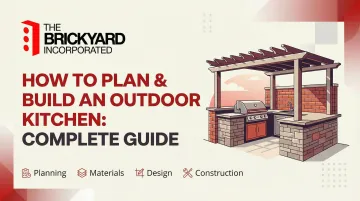
This guide walks through the complete process of planning and building an outdoor kitchen, from site selection and layout to framing, materials, and finishing. Whether you're working on a compact Milwaukee lot or a sprawling suburban yard, the principles remain the same: plan thoroughly, choose weather-resistant materials, and respect local codes.
TLDR
- Building an outdoor kitchen involves four phases: planning, material selection, construction, and utility hookup
- Decide location, layout configuration (L-shape, linear, U-shape), and utility access before construction begins
- Choose weather-resistant materials like brick, cultured stone, natural stone pavers, and stainless steel for lasting durability
- Permits are required for gas, electrical, and plumbing work; check local codes first
- Skilled homeowners can handle framing themselves, but utility connections require licensed professionals
Planning Your Outdoor Kitchen
The planning phase determines whether your outdoor kitchen project succeeds or fails. Decisions made here affect every downstream step, cost, and timeline. Rushing this stage is the single most common mistake homeowners make.
Choosing the Right Location
You have two primary placement options: adjacent to the house or freestanding in the yard. Adjacent placement offers easier utility access but less creative freedom. Freestanding islands provide more design flexibility but drive up utility connection costs.
Utility trenching costs matter:
- Standard trenching in dirt: $5–$12 per linear foot
- Complex trenching through hardscape: $13–$40 per linear foot
- Directional boring (under patios/driveways): $30–$60 per linear foot
A 50-foot utility run to a freestanding island can add $600 to $3,000 in excavation costs alone, not including the gas/electrical lines or hardscape restoration.
Climate considerations for Milwaukee:Account for shade, prevailing wind direction, and drainage when evaluating a location. Milwaukee's prevailing winds frequently come from the northwest, so position your kitchen where the house or an existing wall blocks wind to prevent smoke from blowing into seating areas. Proper drainage prevents water from pooling around your foundation during Wisconsin's heavy spring rains.
Layout Configurations and Kitchen Zones
Choose your layout based on available space and how you plan to use the kitchen. The four common configurations each serve different needs:
Linear (Straight Run):
- Best for small urban lots or tight spaces
- All zones along a single wall
- Cost-effective but limited counter space
- No natural work triangle
L-Shaped:
- Continuous counter space on two adjacent walls
- Creates natural work triangle
- Separates cooking from traffic flow
- Allows bar seating on one side
U-Shaped:
- Maximum counter space for larger areas
- Three walls of workspace
- Great for multiple cooks
- Requires significant square footage
Galley:
- Two parallel runs with walking area between
- Highly efficient for a single cook
- Can feel cramped if aisle is too narrow
- Requires minimum 42-inch aisle width
The four functional zones every outdoor kitchen needs:
- Cooking — grill station, burners, or pizza oven
- Cooling — refrigeration for drinks, prep ingredients, and perishables
- Clean-up — sink with hot/cold water for prep and post-meal cleanup
- Storage — drawers, doors, and shelving for tools, propane, and supplies
Separating these functions prevents bottlenecks when entertaining. The National Kitchen & Bath Association recommends arranging them in a triangle pattern — the same principle used in indoor kitchen design — to minimize unnecessary movement between tasks.
Budget and Permits
Outdoor kitchen cost tiers (2025/2026):
- Basic builds: $4,000–$10,000 (compact grill island, minimal storage, prefab kits)
- Mid-range builds: $10,000–$20,000 (built-in grill, prep space, storage, 1-2 appliances)
- Premium builds: $20,000–$50,000+ (custom masonry, multiple appliances, bar seating, full utilities)
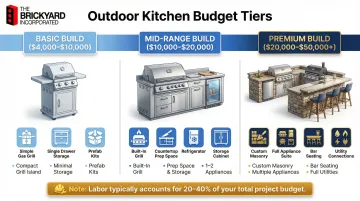
Labor typically accounts for 20-40% of the total budget. Utility connections (gas, plumbing, electrical) and materials selection are the two biggest cost drivers.
Permit requirements:Most jurisdictions require building permits for structures with gas, electrical, or plumbing work. In Milwaukee, the Department of Neighborhood Services enforces Wisconsin Building Code (SPS 320-325). Contact your local building department early—permit timelines can delay construction starts by weeks.
The hidden cost of unpermitted work:Homeowners insurance companies can deny claims if damage was caused by unpermitted, uninspected work. In Wisconsin, sellers must disclose known unpermitted work on real estate condition reports. Non-disclosure can lead to delayed sales, reduced property values, or post-sale legal action.
Choosing the Right Materials
Outdoor kitchen materials must withstand UV exposure, moisture, freeze-thaw cycles (particularly relevant in Wisconsin's climate), and heat. Indoor materials will fail prematurely and create safety hazards.
Frame and Foundation Options
Frame material trade-offs:
| Frame Material | Durability & Climate Suitability | Cost & Installation |
|---|---|---|
| Pressure-Treated Wood | Susceptible to warping and rot if exposed to moisture; must be AWPA UC4A/B rated for ground contact | Cost-effective and DIY-friendly; requires regular maintenance |
| Galvanized Steel | Zinc coating resists rust but can wear down in humid environments; 15-20 year lifespan | Affordable and strong; prone to rust over time |
| Stainless Steel (304/316) | Excellent corrosion resistance; handles freeze-thaw and humidity effortlessly; 25-30+ year lifespan | Higher upfront cost but best long-term ROI |
| Concrete Block (CMU) | Extremely durable, fire-resistant, performs well in freeze-thaw cycles | Heavy; requires skilled masonry labor and robust foundations |
For Milwaukee's humid summers and freezing winters, stainless steel or concrete block frames offer the best long-term value by preventing internal rot and corrosion.
Foundation requirements:Your kitchen must sit on a level, load-bearing surface. Wisconsin's average frost depth reaches 48 inches, which creates specific foundation challenges.
Concrete slabs:
- Minimum 4 inches thick for standard installations
- Slope 1/4 inch per foot for drainage
- Air-entrained concrete with water-cementitious ratio ≤0.50 for freeze-thaw durability
- Heavy masonry islands require thickened slab edges or footings below the 48-inch frost line
Paver bases:
- Minimum 4 inches of compacted aggregate base for pedestrian patios
- Cold climates with wet/weak soils require bases 2-4 inches thicker
- Offers flexible, attractive base that integrates naturally with surrounding hardscape
Cladding and Countertop Materials
Cladding is the exterior finish applied over the frame. Weather-rated materials are essential for Wisconsin's climate.
Cladding options:
- Brick: Must meet ASTM C216 Grade SW (Severe Weathering) for high freeze-thaw resistance
- Cultured stone: Must comply with ASTM C1670 (≤1.5% mass loss after 50 freeze-thaw cycles)
- Natural stone veneer: Dense stone handles freeze-thaw cycles better than porous varieties
- Stucco/tile: Requires proper waterproofing and exterior-rated adhesives
The Brickyard carries brick, cultured stone, natural stone, and thin brick options suited for outdoor applications in the Milwaukee area — all sourced to meet severe weathering ratings for Wisconsin conditions.
Countertop material comparison:
| Material | Porosity & Sealing | Heat & UV Resistance | Freeze-Thaw Performance |
|---|---|---|---|
| Granite | Porous; requires regular sealing | Excellent heat and UV resistance | Good, if fissures don't trap water |
| Concrete | Highly porous; requires rigorous sealing | Good heat resistance; color may fade | Prone to hairline cracking |
| Porcelain Tile | Low porosity; grout lines need sealing | Good heat resistance; UV stable | Good if properly installed |
| Sintered Stone (Dekton) | Non-porous; no sealing required | Passes thermal shock tests; highly UV stable | Excellent; zero-porosity prevents ice damage |
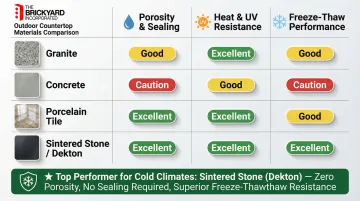
Sintered stone offers the most resilience for Wisconsin winters, as its zero-porosity surface prevents ice expansion damage.
Appliances and Utility Planning
Essential appliances:With your structural materials chosen, appliance selection becomes the next critical constraint — cutout dimensions and clearance requirements directly determine frame dimensions and island depth. The built-in grill head is selected first, with optional additions including side burners, refrigerator, sink, ice maker, warming drawer, and pizza oven finalized before framing begins.
Manufacturer clearance requirements:Different grill manufacturers specify different clearances to combustibles:
- Weber Summit Built-In: 24 inches rear and side clearance
- Napoleon Built-In Series: 17 inches rear, 9 inches side clearance
- Lynx Professional: 6.25 inches rear, 12 inches side clearance
Always design island depth and placement based on your specific grill manufacturer's requirements.
Utility rough-in planning:Gas, electrical, and water rough-ins need to be mapped on paper and coordinated with licensed contractors before construction begins. The 2023 National Electrical Code requires GFCI protection for all outdoor outlets. All outdoor plumbing in Milwaukee's climate must include indoor shut-off valves and low-point drains for complete winterization.
Step-by-Step: Building Your Outdoor Kitchen
Outdoor kitchen construction follows a defined sequence: structural work, then utility rough-ins, then finishing. Skipping steps or working out of order causes rework, failed inspections, and added cost.
Step 1 – Site Preparation
Clear and level the area, remove vegetation and roots, and confirm the ground is stable. You have two foundation options:
Concrete slab:
- Excavate 6-8 inches deep
- Install 4 inches of compacted gravel base
- Pour 4-inch concrete slab with proper slope (1/4 inch per foot)
- Allow 7 days for curing before building
Paver base:
- Excavate 8-10 inches deep (deeper in cold climates)
- Install landscape fabric
- Add 6-8 inches of compacted gravel in 2-inch lifts
- Top with 1 inch of leveling sand
- Install pavers in desired pattern
Step 2 – Frame Construction
Build the frame using pressure-treated 2×4 boards or steel studs:
- Cut materials to size based on your layout plan
- Assemble frame sections (modular sections are stronger and easier to level than one large frame)
- Attach outdoor-rated furniture glides to keep wood off the ground
- Check for square and level throughout using a 4-foot level
- Anchor frame to foundation using concrete anchors or construction adhesive
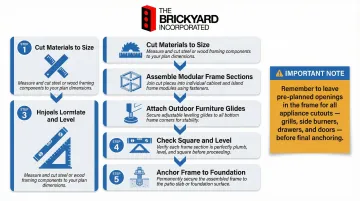
Leave openings for appliance cutouts based on manufacturer specifications, including required clearances.
Step 3 – Cladding and Waterproofing
The cladding process protects your frame from weather and creates the finished aesthetic:
- Attach exterior-rated sheathing (cement board for tile/stone, plywood for other finishes)
- Apply builder's felt and wire lath if using mortar-set veneer
- Mix and apply mortar bed in sections
- Set brick, stone, or tile, working from bottom to top
- Seal joints using exterior-rated grout and sealant
Use exterior-rated adhesives and grouts throughout — moisture intrusion is the most common cause of long-term damage. Seal every utility penetration before moving to the next phase.
Step 4 – Countertop and Cabinet Installation
Install countertops and cabinetry in this order:
- Position the countertop slab or tile surface, confirming cutouts align with appliance specs
- Seal all edges to prevent water infiltration
- Install cabinet doors and drawer hardware — use marine-grade or stainless steel fittings to resist moisture and UV damage
- For stone slabs, apply construction adhesive rated for outdoor use and verify the substrate supports the full slab weight
Step 5 – Utility Connections and Final Inspection
Once framing is complete, licensed professionals should run:
- Gas lines (requires permit and pressure testing)
- Electrical conduit with GFCI-protected outlets
- Water supply and drain lines with shut-off valves and winterization drains
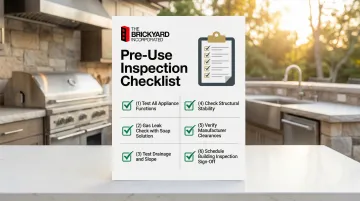
Final walkthrough checklist:
- Test all appliance functions
- Perform gas leak check using soap solution
- Test drainage and confirm proper slope
- Check structural stability
- Verify all clearances meet manufacturer specs
- Schedule building inspection sign-off before first use
Common Outdoor Kitchen Mistakes and How to Avoid Them
Skipping the Permit Process
Most homeowners don't realize how many outdoor kitchen elements trigger a permit — gas line work almost universally does. Starting without one isn't just a paperwork issue; uninspected work can void homeowner's insurance and complicate future resale.
Fix: Contact your local building department before any work begins.
Using Indoor or Non-Rated Materials
Using interior-grade materials outdoors is one of the most common (and costly) mistakes — finishes, cabinets, and appliances can fail within a season or two when they're not built for outdoor exposure.
Fix: Verify every material carries an outdoor, marine, or weather-resistant rating — from cabinet hardware to countertop sealant. In Wisconsin's climate, freeze-thaw testing standards are non-negotiable.
Poor Utility Access Planning
Finalizing a layout before consulting a plumber or electrician often means appliances end up far from existing gas, electrical, or water lines — and routing new lines across a yard gets expensive fast.
Fix: Get a utility assessment before locking in the layout. Staying close to the house's existing infrastructure is one of the easiest ways to keep connection costs in check.
Pro Tips for a Better Outdoor Kitchen Build
A few decisions made early — or avoided until too late — consistently separate smooth builds from expensive ones. These three tips come up repeatedly among experienced outdoor kitchen builders.
Build More Counter Space Than You Think You Need
Experienced outdoor cooks consistently report that counter space is the most underestimated element in outdoor kitchen design. The National Kitchen & Bath Association recommends a minimum of 12 inches of landing area on one side of a cooking surface and 15 inches on the other side. If your layout allows, go further — you'll use every inch.
Plan for Winterization Before Construction Starts
In cold-weather climates like Wisconsin, install shut-off valves on all water lines so they can be drained before freezing temperatures arrive. For materials, dense natural stone and fired brick handle freeze-thaw cycles without cracking — a critical consideration in southeastern Wisconsin's climate. Leave outdoor faucets and low-point drains open during winter to accommodate minor ice expansion.
Get All Your Trades in a Room Together Before Breaking Ground
Schedule your electrician, gas plumber, and general contractor to review the plan together rather than sequencing them one at a time. This single step prevents the most common schedule delays and budget overruns in outdoor kitchen builds.
Frequently Asked Questions
How much does it cost to install an outdoor kitchen?
Basic builds start at $4,000–$10,000 for compact grill islands with minimal features. Mid-range projects run $10,000–$20,000 with built-in grills and 1-2 appliances. Premium custom builds exceed $20,000–$50,000+ with full utilities and multiple appliances. Utility connections (gas, plumbing, electrical) and materials selection are the two biggest cost drivers.
What permits are needed for an outdoor kitchen?
Permits are typically required for gas, electrical, and plumbing work. Structural permits may apply for permanent installations. In Milwaukee, the Department of Neighborhood Services enforces Wisconsin Building Code requirements. Verify specific requirements with your local building department early in the planning process.
What is the best material for an outdoor kitchen structure?
Each main structural option has distinct trade-offs:
- Concrete block and masonry (brick, natural stone) — most durable, with excellent fire resistance and freeze-thaw performance
- Steel stud framing (stainless steel preferred) — strong, corrosion-resistant, and lighter than masonry
- Pressure-treated wood — lowest cost, but requires sealing and protective cladding
How far should an outdoor kitchen be from the house?
For single-family homes, your grill manufacturer's clearance requirements determine safe placement — not the commonly cited "10-foot rule," which applies to multifamily buildings. Most built-in grills require 6–24 inches of clearance to combustibles depending on the model. Always follow your specific installation manual.
Can I build an outdoor kitchen on a deck?
Yes, but the deck must be structurally reinforced for the added weight, and fire clearance requirements must be met. Grills cannot sit directly on combustible wood or composite decking without specialized insulated jackets — have a structural engineer or contractor verify load capacity before building.
Do I need to cover my outdoor kitchen?
A pergola, overhang, or roof structure extends usability and protects appliances from weather, but isn't required. Cooking appliances must maintain manufacturer-specified clearance above any overhead structure. Installing a grill under combustible overhead construction requires a UL 710-approved vent hood that operates whenever the grill is in use.