![How Much Does a Concrete Driveway Cost? [2026 Data]](https://file-host.link/website/thebrickyardwi-ie8696/assets/blog-images/739cc277-5d64-4828-9270-a102416927f6/1773750842598882_49b91909279c4e368a23cf8c2c9823b3/360.webp)
Introduction
A concrete driveway ranks among the most durable and value-adding investments a homeowner can make. Nationally, costs have shifted since 2020 due to sustained material inflation and labor shortages, with ready-mix concrete prices tracked by the Producer Price Index reaching 388.263 in early 2026. Today, most homeowners budget between $2,700 and $14,500 for a complete installation, depending on project scope.
Size, finish, thickness, site conditions, and location each pull that number in different directions. A basic single-car pad runs around $3,000. A large stamped two-car driveway can reach $15,000. Both figures are accurate — for very different projects.
This guide covers exact pricing by tier and size, the factors that move costs up or down, a full cost breakdown, and how to budget and save without cutting corners.
TL;DR
- Concrete driveway costs range from $6 to $20+ per square foot installed, with most homeowners spending $2,700 to $14,500 total
- Size, finish complexity, slab thickness, and local labor rates drive the final price
- Plain gray concrete is the most affordable option; stamped or decorative finishes can double the cost
- Wisconsin homeowners need 5–6 inch thickness and air-entrained concrete to survive freeze-thaw cycles — both affect material cost
- Get at least three quotes from licensed contractors; budget for sealing upfront to protect the slab long-term
How Much Does a Concrete Driveway Cost?
There is no single fixed price for a concrete driveway. The range is wide because project variables—size, finish, thickness, regional labor markets—all interact to determine final cost.
According to 2026 industry data, installed concrete driveway prices range from $8 to $20 per square foot nationally, with the average residential project totaling $6,400.
Cost by Driveway Size
| Driveway Size | Square Footage | Average Total Cost |
|---|---|---|
| 10×20 (Single-car) | 200 sq. ft. | $2,300 ($1,600–$3,000) |
| 12×24 (Large single) | 288 sq. ft. | $3,300 ($2,300–$4,300) |
| 20×20 (Two-car) | 400 sq. ft. | $4,600 ($3,200–$6,000) |
| 24×24 (Large two-car) | 576 sq. ft. | $6,600 ($4,600–$8,600) |
| 24×36 (Three-car) | 864 sq. ft. | $9,950 ($6,900–$13,000) |
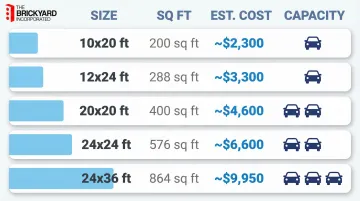
These figures assume standard or basic concrete and include material, labor, and basic site prep. They exclude major excavation, old driveway removal, and permits.
Standard Concrete (Plain Gray)
The entry-level option is plain gray concrete with a broom or basic salt finish (no decorative treatments). Costs run $6 to $8 per square foot.
What's included:
- Concrete material (typically 3,000–3,500 PSI)
- Basic labor for forming, pouring, and finishing
- Standard 4-inch pour depth
What's not included:
- Decorative finishes or coloring
- Rebar or wire mesh reinforcement
- Old driveway removal
- Professional sealing
Best for: Budget-conscious homeowners, rental properties, utility driveways, or anyone prioritizing function over aesthetics.
Basic to Mid-Range Decorative Concrete
Mid-tier options include single-color integral staining, exposed aggregate, textured broom finishes, basic stenciling, or simple stamped patterns. Costs range from $8 to $12 per square foot for basic decorative work and $12 to $18 per square foot for mid-range designs.
Cost drivers within this tier:
- Number of colors used
- Pattern complexity
- Specialized labor skill required
- Timing and coordination during finishing
Best for: Homeowners wanting curb appeal improvements at a moderate price without committing to fully custom work.
High-End Custom Concrete
Premium options include multi-color stamping, hand-applied chemical stain accents, custom borders, advanced stenciling, and saw-cut designs. Expect to pay $18 to $25+ per square foot.
The premium reflects specialized labor, longer installation time, and artistic skill. High-end concrete can closely mimic natural stone, brick, or tile at a fraction of the cost of those materials, which makes it a practical choice for homeowners who want an upscale look without switching material types entirely.
Key Factors That Affect the Cost of a Concrete Driveway
Several variables combine to determine your final concrete driveway cost: square footage, mix type, finish, site prep, reinforcement, and where you live. Understanding each one helps you budget accurately and avoid surprises.
Driveway Size and Thickness
Total square footage is the single largest driver of project cost. Larger driveways require more concrete, more labor, and longer installation time.
Thickness matters significantly:
- 4 inches: Standard for residential passenger vehicles (3,000–6,000 lbs)
- 6 inches: Recommended for trucks, SUVs, or RVs (up to 12,000 lbs)
- 8 inches: Required for heavy commercial vehicles
Increasing thickness from 4 to 5 inches boosts load-carrying capacity by nearly 50% but adds approximately 20% to material costs.
In cold climates like Wisconsin, contractors often recommend 5–6 inch pours due to freeze-thaw stress. Midwest homeowners should factor this into their budgets.
Concrete Type and Finish
Different concrete mixes carry different price tags. Ready-mix concrete costs between $160 and $195 per cubic yard nationally, with specialty mixes commanding premiums.
Cost per cubic yard by mix type:
- All-Purpose (3,000–3,500 PSI): $120–$170
- High-Strength (4,000+ PSI): $160–$210
- Self-Consolidating Concrete: $195–$215
- Fiber-Reinforced: $150–$200
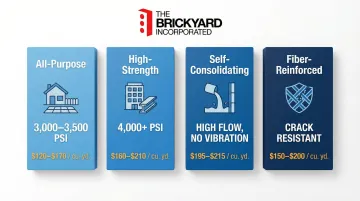
Upgrading from a plain broom finish to stamped or stained concrete can nearly double per-square-foot labor costs — skilled finishing work takes more time and must be completed before the concrete sets.
Labor and Site Preparation
Labor typically accounts for $2 to $10 per square foot of the total project cost. Site prep includes:
- Grading and leveling
- Excavation
- Subbase installation (gravel or sand)
- Forming and bracing
All of these add cost before a single cubic yard of concrete is poured.
Removal of existing driveway:
- Concrete tear-out: $2–$6 per square foot
- Asphalt removal: $3–$7 per square foot
Additional Cost Factors
Reinforcement:
Reinforcement extends driveway life, especially for heavier vehicles.
Sealing:
- Professional sealing: $1.35–$2.50 per sq. ft.
- Recommended every 2–3 years for longevity
Geographic location:Remote areas and high cost-of-living metros push pricing toward the upper end of national ranges. In the Milwaukee area specifically, seasonal demand and delivery distances from suppliers can affect what contractors quote — especially during peak spring and summer construction season.
Concrete Driveway Cost Breakdown
The sticker price a contractor quotes typically bundles multiple cost categories. Understanding what each component costs helps homeowners evaluate quotes accurately and spot what's missing.
Main Cost Components
- Concrete material — Priced per cubic yard. Calculate what you need using (Length × Width × Depth in feet) ÷ 27, then add 10–15% for spillage and uneven subgrades.
- Labor — Forming, pouring, and finishing typically make up the largest share of any quote.
- Site preparation — Excavation, grading, and subbase material. Contractors often quote this separately or itemize it in the bid.
- Add-ons and finishing — Sealer, rebar, and decorative upgrades are one-time or periodic costs that can add $500–$2,000+ to the total.
Knowing what's included is only half the picture. Several costs commonly fall outside the base quote entirely.
What's Typically Excluded
Confirm with your contractor whether these are included:
- Permitting fees
- Old driveway removal
- Drainage work
- Landscaping restoration after installation
Permits are required in many municipalities before pouring concrete. In Milwaukee, a driveway installation permit totals $350 ($200 application + $125 plan review/inspection + $25 processing).
Concrete vs. Other Driveway Materials
| Material | Installed Cost (Per Sq. Ft.) | Expected Lifespan | Maintenance Requirements |
|---|---|---|---|
| Poured Concrete | $8–$20 | 30–40 years | Low; seal every 2–3 years. Vulnerable to de-icing salts. |
| Asphalt | $7–$15 | 15–30 years | Moderate; requires sealcoating every 2–5 years. |
| Concrete/Brick Pavers | $10–$30 | 25–50+ years | Moderate; requires re-sanding joints and weed control. |
| Gravel | $1–$4 | 10–100 years | High; requires frequent raking, grading, and replenishment. |
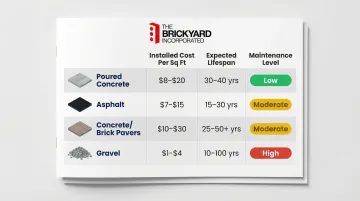
While asphalt has a lower upfront cost, concrete's longer lifespan and lower maintenance needs often make it the more economical long-term choice—especially in moderate climates.
Cold-Climate Considerations
In cold-weather states like Wisconsin, asphalt has some advantages in freeze-thaw flexibility. However, a properly installed and sealed concrete driveway with an adequate subbase and thickness handles Midwest winters well.
For concrete to hold up against freezing, thawing, and de-icing chemicals, the mix needs to meet these minimums:
- Maximum water-to-cement ratio of 0.45
- Minimum compressive strength of 4,500 PSI
- 6% air entrainment
One additional note on de-icers: sodium chloride and calcium chloride accelerate surface scaling. Skip chemical de-icers entirely during the first winter—use clean sand for traction instead.
Paver and Natural Stone Alternatives
Poured concrete isn't the only option. Brick, concrete pavers, and natural stone each let you customize patterns, colors, and layouts in ways a single pour can't match. Individual units can also be replaced if one cracks or shifts—something a concrete slab doesn't allow. The Brickyard in Milwaukee stocks pavers, brick, and natural stone for homeowners and contractors exploring hardscape alternatives across Southeastern Wisconsin.
How to Budget Smart and Save on Your Concrete Driveway
Practical Budgeting Strategies
- Get at least three quotes from licensed, insured contractors — compare what each includes, not just the bottom-line price. A low bid that omits site prep or sealing often costs more in the end.
- Schedule in fall if your timeline allows. Spring and summer drive up contractor demand and prices.
- Keep the design simple. Each decorative upgrade adds real cost — prioritize the features that matter and skip the rest.
Common Budgeting Mistakes
- Focusing only on the pour price, without budgeting for sealing, maintenance, and eventual repairs
- Hiring the cheapest contractor without checking references or reviewing past work
- Over-specifying thickness beyond actual need — a 4-inch pour handles most residential vehicles; 6 inches is only worth the extra spend if you're parking heavy equipment
Long-Term Value Thinking
A properly installed concrete driveway can return 50–80% of its cost in home value, lasts 25–40 years with basic maintenance, and requires far less ongoing spending than asphalt.
Spending slightly more upfront on quality materials and an experienced contractor typically costs less over the driveway's lifetime than skimping on materials or labor and facing early repairs.
Frequently Asked Questions
How much does it cost to pour a 20×20 concrete driveway?
A 20×20 driveway (400 sq. ft.) costs $3,200 to $6,000 for standard concrete and $4,800 to $7,200 for decorative finishes. Site conditions, thickness, and location can shift the final number.
How much is a 100-foot concrete driveway?
A "100-foot driveway" refers to length — total cost depends on width. At $8–$20/sq. ft., a standard 12-foot-wide driveway (1,200 sq. ft.) runs $9,600–$24,000. Narrower 10-foot driveways start around $8,000; wider 16-foot driveways can reach $32,000.
Is a concrete driveway cheaper than asphalt?
Asphalt generally has a lower upfront cost ($7–$15/sq. ft.), but concrete's longer lifespan (30–40 years vs. 15–30 for asphalt) and lower maintenance requirements often make it the more cost-effective option over time—particularly where freeze-thaw cycles are less severe.
Is 4 inches of concrete enough for a driveway?
Yes, 4 inches is the standard minimum for residential driveways used by passenger vehicles. However, 6 inches is recommended for households with trucks, RVs, or heavy vehicles. Cold-climate regions may benefit from the added thickness for freeze-thaw durability.
How long does a concrete driveway last?
A concrete driveway lasts 25–40 years with proper maintenance. Quality of installation, climate, vehicle load, and regular sealing all influence longevity.
How can I save money on a concrete driveway without sacrificing quality?
Get multiple quotes, schedule off-peak, choose a simpler finish, and invest in proper thickness and sealing upfront to avoid costly repairs later. Sealing alone costs $0.50–$1.50/sq. ft. and can extend driveway life by 5–10 years.