Introduction: Should You Install a Concrete Driveway?
Milwaukee homeowners face unique driveway challenges that can shorten the lifespan of even well-built installations. With 48.7 inches of annual snowfall and repeated freeze-thaw cycles throughout winter, choosing the wrong material leads to cracking, costly repairs, and premature replacement. Water that seeps into concrete expands by roughly 9% when it freezes, generating significant stress within the slab—and when chemical deicers enter the equation, that damage accelerates dramatically.
Concrete driveways remain popular for good reasons: they're affordable, they produce a clean finished surface, and they can last 25–30 years under the right conditions. But they come with real trade-offs. Before committing thousands of dollars, Milwaukee homeowners need to weigh whether concrete is actually the best fit for their property and climate.
This guide breaks down what installation actually involves, what it costs upfront and long-term, how to maintain concrete through Wisconsin winters, and what alternatives to consider if concrete isn't the right call.
TLDR:
- Concrete driveways cost $8–$20 per square foot installed, with total projects averaging $6,400 nationwide
- Installation requires 8–12 inches of excavation, a compacted gravel base, and at least a 4-inch slab
- Seal every 2–3 years and avoid salt-based deicers for the first year — Wisconsin winters demand it
- Pavers flex with ground movement through freeze-thaw cycles instead of cracking like poured concrete
- If repair costs top 50% of replacement cost, it's time to look at alternatives
What Goes Into a Concrete Driveway Installation
Understanding the installation process helps you ask contractors the right questions, set realistic timelines, and recognize shortcuts before they become expensive problems. Concrete work requires specialized equipment, precise timing, and hands-on experience — this is not a weekend DIY project.
Preparing the Site
Proper site preparation is the foundation of driveway longevity. Skipping or rushing this step is the leading cause of early cracking in Wisconsin driveways, where freeze-thaw cycles exploit any weakness in the base.
Site prep includes:
- Excavate 8–12 inches of soil to reach stable ground, removing organic material that decomposes and settles over time
- Grade for a minimum 1–2% slope (1/8 to 1/4 inch per foot) away from your home to prevent water pooling
- Compact 4–8 inches of crushed stone sub-base to 95% density — this resists frost heave, which is especially critical in Wisconsin
- Set wooden or metal formwork to define the driveway's shape and thickness; forms must be level and secure before pouring
Standard residential driveways should be poured at a minimum of 4 inches thick. If you park heavier vehicles (SUVs, trucks, RVs), specify 5–6 inches to handle the additional load without cracking.
Control joints are critical but often misunderstood. These are intentional grooves cut or tooled into the slab every 8–12 feet (roughly 2 to 2.5 times the slab thickness in feet). Without them, concrete cracks unpredictably across the surface.
For a 4-inch slab, joints should be cut 1 inch deep — approximately 1/4 the slab thickness. This gives the concrete a controlled location to flex rather than fracturing randomly.
Pouring and Curing the Concrete
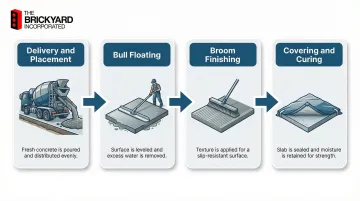
Once the site is prepared, the concrete pour follows a precise sequence:
- Delivery and placement: Concrete arrives by truck and must be spread and screeded to level within a tight working window
- Bull floating: The surface is smoothed to close air pockets and bring a thin layer of cement paste to the top
- Broom finishing: A broom texture is applied for traction, especially important for winter safety
- Covering and curing: The slab is covered or misted to begin the curing process
The 90-minute rule: Historically, ASTM C94 required concrete to be discharged within 90 minutes of batching to prevent premature setting. In 2021, ASTM C94-21 removed this default limit, now requiring purchasers and contractors to establish acceptable batch-to-discharge windows before delivery. Exceeding the agreed window compromises workability and final strength—make sure your contract specifies this clearly.
Curing timeline:
- 24–48 hours: Light foot traffic is safe
- 7 days minimum: Before allowing vehicle traffic
- 28 days: Full design strength is reached (typically 4,000 psi)
Keep vehicles off the new slab for at least 7 days — rushing this step causes surface damage and undermines long-term strength.
How Much Does a Concrete Driveway Cost?
Concrete driveway costs depend on size, site conditions, and finish type — and the upfront price is only part of the story. Long-term ownership costs, especially in Milwaukee's freeze-thaw climate, can shift the math considerably.
Upfront Installation Costs
National averages for poured concrete driveways range from $8 to $20 per square foot, with total projects averaging $6,400 (typical range: $2,700 to $14,500). Milwaukee-area costs run approximately 3% above the national average, with mid-range projects averaging around $4,900.
Primary cost variables include:
- Driveway size: A standard two-car driveway (20×20 feet = 400 sq ft) costs $3,200–$8,000 at $8–$20/sq ft
- Demolition: Removing an existing concrete driveway adds $1–$3 per square foot
- Slab thickness: Going from 4 inches to 5–6 inches increases material costs by 25–50%
- Reinforcement: Wire mesh is standard; rebar adds strength but increases cost
- Decorative finishes: Exposed aggregate ($8–$12/sq ft), stamped concrete ($12–$18/sq ft), or integral color ($18–$20/sq ft)
Important note on decorative finishes: While stamped concrete and exposed aggregate add visual appeal, they don't necessarily improve durability. Stamped surfaces can show wear and cracking more visibly under vehicle traffic, and the texture can trap moisture that accelerates freeze-thaw damage.
Long-Term Cost of Ownership
Those upfront numbers don't include what you'll spend maintaining the slab over time. In Milwaukee's climate, that maintenance cycle is more demanding than in warmer regions.
Ongoing maintenance costs:
- Sealing: $1.35–$2.50 per square foot every 2–3 years, averaging $1,500 per application
- Crack repair: $0.50–$3.00 per linear foot for minor hairline cracks
- Section replacement: When major cracks or heaving occur, the only real fix is demolition and re-pouring of affected sections, which can rival the cost of the original installation
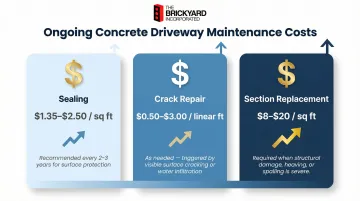
That last point is worth weighing carefully. When a concrete slab develops structural failure, replacing damaged sections costs $8–$20/sq ft — essentially starting over. Pavers cost more upfront ($10–$30/sq ft), but individual damaged units can be swapped out for a fraction of that, often just the cost of replacement pavers and minimal labor.
How to Maintain a Concrete Driveway
Concrete maintenance is manageable but non-negotiable in Wisconsin. Homeowners who skip routine care see their driveway lifespan cut significantly, while those who follow a simple annual schedule can realistically get 25–30 years out of a well-installed slab.
Sealing and Cleaning
Sealing delivers the best return on any maintenance dollar you'll spend. A penetrating silane or siloxane sealer — not just a surface coating — is recommended for freeze-thaw climates because it blocks chloride ingress without trapping subsurface moisture that can cause spalling.
Sealing guidelines:
- First application: 30 days after initial cure, once the slab has reached sufficient strength
- Resealing frequency: Every 2–3 years (some penetrating sealers last up to 5 years)
- What to look for: Breathable penetrating sealers that chemically react with concrete, not film-forming acrylics that trap moisture
Proper cleaning:
- Routine rinsing and occasional pressure washing to remove oil, salt, and debris
- Avoid wire brushes or harsh chemicals that erode the surface
- Treat oil stains promptly before they penetrate—use absorbent materials like cat litter, then clean with a degreaser
Winter and Seasonal Care
Deicing chemicals cause more long-term damage to concrete driveways than almost any other factor. Rock salt (sodium chloride) is particularly destructive, especially in the first few years when the concrete is still maturing — it increases saturation levels, triggers thermal shock during freeze-thaw cycles, and creates osmotic pressures that break down the cement matrix.
Winter care best practices:
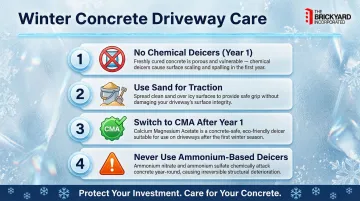
- Avoid all chemical deicers for the first 12 months after installation — this is critical for long-term durability
- Use clean sand for traction instead of salt, especially during the first winter
- After the first year, switch to calcium magnesium acetate (CMA) instead of rock salt — it's significantly less corrosive, though still not completely benign
- Never use ammonium sulfate or ammonium nitrate deicers — these fertilizer-based products will rapidly destroy concrete
Spring maintenance:
- Keep expansion joints clear of debris
- Inspect for new cracks each spring
- Fill small hairline cracks immediately before water infiltrates and worsens them over the next winter
Common Concrete Driveway Problems (and How to Fix Them)
Concrete driveways in cold climates fail in predictable ways. Knowing what to look for—and when to repair versus replace—can save thousands of dollars.
Most Common Failure Modes
Milwaukee winters put concrete through a punishing cycle of freeze, thaw, and salt exposure. Three failure modes show up most often:
- Surface scaling/spalling: Flaking or peeling of the finished surface that exposes the coarse aggregate underneath. Freeze-thaw cycles combined with deicer saturation are the main culprits.
- Cracking: Shrinkage cracks (hairline, under 1/8 inch) are cosmetic. Structural cracks wider than 1/4 inch — especially those with vertical displacement — signal subgrade failure.
- Slab heaving: Sections lift and shift when water in the soil or subbase freezes and expands, usually due to a poorly prepared base.
Repair Options and Their Limitations
Minor crack filling works well for surface-level damage. Crack fillers and patching compounds stop water intrusion and keep small cracks from widening, typically running $0.50–$3 per linear foot. The tradeoff: repairs will always be visible and rarely match the original surface color.
For structurally failed slabs, patching is a waste of money. If the base has failed or the slab has heaved significantly, surface patching won't fix the underlying problem — the damage will return.
When to Repair vs. When to Replace
A straightforward benchmark: if repair estimates exceed 50% of the cost of a new slab, replacement is more cost-effective over the long run.
Replace the slab rather than patch it when:
- More than 25–30% of the surface has significant cracking
- Cracks exceed 1/4 inch wide or show vertical displacement
- Multiple sections have heaved due to base failure
- The slab slopes toward your foundation, directing water toward the house
When replacement becomes necessary, it's worth considering whether poured concrete is still the right fit — or whether a different material would hold up better over time.
Concrete Driveway Alternatives Worth Considering
Concrete isn't the right fit for every Milwaukee property. Climate, budget, aesthetics, and long-term maintenance all factor in — and several alternatives are worth a hard look before you commit.
Concrete Paver Driveways: The Premium Alternative
Pavers are the superior choice for freeze-thaw climates. Individual interlocking units flex with ground movement rather than cracking as a monolithic slab. This flexibility is exactly what Milwaukee's freeze-thaw cycles demand.
Key advantages:
- Invisible repairs: Replace individual damaged pavers without leaving visible patches
- Design versatility: Unlimited patterns, colors, and natural stone finishes
- Longer lifespan: 30–50 years with proper maintenance, compared to 25–30 for concrete
- Resale value: A well-laid paver driveway consistently adds more curb appeal — and appraised value — than poured concrete
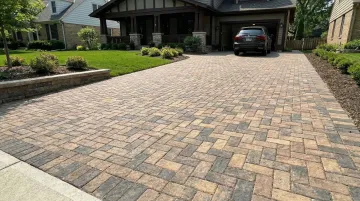
Cost: Pavers run $10–$30 per square foot installed—higher upfront than concrete, but the long-term value often justifies the investment when you factor in lower maintenance and repair costs.
The Brickyard stocks pavers, natural stone, and reclaimed brick for projects across the Milwaukee area. Their inventory includes Milwaukee Cream City brick, Chicago Pink brick, reclaimed street pavers, and granite cobbles — materials you won't find at big-box retailers, and options that bring genuine historical character to a driveway.
Other Alternatives
| Asphalt | Gravel / Permeable | |
|---|---|---|
| Cost | $7–$15 per sq ft | Lowest upfront |
| Lifespan | 15–30 years | Varies; ongoing upkeep |
| Maintenance | Sealcoat every 3–5 years | Periodic regrading |
| Drainage | Poor without grading | Excellent — drains through surface |
| Best for | Budget-conscious installs, fast turnaround | Rural or rustic properties |
| Drawbacks | More frequent upkeep, less curb appeal | Hard to plow; shifts over time |
Frequently Asked Questions
How much does a concrete driveway cost?
Concrete driveways typically cost $8–$20 per square foot installed, with total project costs averaging $6,400 nationwide. Final price depends on driveway size, site prep needs, slab thickness, and decorative finishes, plus ongoing maintenance like sealing every 2–3 years and eventual repairs.
What is the 90-minute concrete rule?
The 90-minute rule historically required concrete to be discharged within 90 minutes of batching to prevent premature setting. In 2021, ASTM C94-21 removed this default limit, now requiring contractors and purchasers to establish acceptable time windows before delivery. Exceeding the agreed window compromises workability and final slab strength.
How long does a concrete driveway need to cure before you can drive on it?
Light foot traffic is safe after 24–48 hours, but vehicle traffic should be avoided for at least 7 days. Full design strength (typically 4,000 psi) is reached at 28 days. Rushing this timeline leads to surface damage and reduced long-term durability.
How long does a concrete driveway last?
A well-installed and properly maintained concrete driveway typically lasts 25–30 years, with some reaching 50 years. In freeze-thaw climates like Wisconsin, lifespan depends heavily on base preparation quality, regular sealing every 2–3 years, and avoiding salt-based deicers, particularly during the first year.
Can I seal a concrete driveway myself?
Yes, DIY sealing is straightforward and cost-effective. Choose a penetrating silane or siloxane sealer over a film-forming acrylic, since surface sealers can trap moisture and cause spalling. The surface must be completely clean and dry before application.
Are paver driveways better than concrete in cold climates?
Yes. Pavers handle freeze-thaw cycles better than poured concrete because each unit moves independently rather than cracking as a rigid slab. That flexibility, combined with the ability to replace individual damaged units without visible patches, makes them a practical choice for Wisconsin homeowners.
![How Much Does a Concrete Driveway Cost? [2026 Data]](https://file-host.link/website/thebrickyardwi-ie8696/assets/blog-images/739cc277-5d64-4828-9270-a102416927f6/1773750851050546_501e13ada9cf4d2fae6b977ce0847b69/1080.webp)