Introduction
A flagstone patio can run anywhere from $2,000 for a small DIY project to $15,000 or more for a professionally installed, mortared design — and that spread trips up a lot of homeowners. Before you commit to a project, the real question is: What will this actually cost me?
Costs shift significantly based on patio size, stone type, installation method, labor rates, and regional factors. Homeowners who plan from a single national average without accounting for their specific scope routinely underbid their own projects by thousands of dollars.
This guide breaks down the full cost picture for 2026, including price ranges by size and method, the factors that move the needle most, and how to budget realistically for a Milwaukee-area or Midwest flagstone project.
TL;DR
- Flagstone patio costs range from $750 to $8,265, with Milwaukee homeowners typically spending around $3,500
- Price is driven primarily by patio size, stone type, installation method (dry-laid vs. wet-laid), and local labor rates
- Smaller, simpler dry-laid patios using sandstone or limestone cost the least; large, custom wet-laid designs with premium bluestone or quartzite cost the most
- Budget for materials, labor, site prep, and sealing — skipping any one of these is where projects go over cost
How Much Does a Flagstone Patio Cost in 2026?
There is no single fixed price for a flagstone patio. Costs shift significantly based on patio dimensions, stone selection, installation approach, and regional labor markets. Homeowners who plan from a single number without understanding these variables often underbid their own projects.
Cost by Patio Size
Flagstone patios are typically priced per square foot, with installed costs ranging from $15 to $32 per square foot. Materials alone run $2–$15 per square foot depending on stone type and sourcing distance.
Installed Cost by Common Patio Dimensions:
| Patio Size | Square Footage | Installed Cost Range |
|---|---|---|
| 7×7 ft | ~49 sq ft | $750–$1,500 |
| 10×8 ft | ~80 sq ft | $1,200–$2,400 |
| 12×12 ft | ~144 sq ft | $2,200–$4,300 |
| 16×18 ft | ~288 sq ft | $4,300–$8,600 |
| 20×20 ft | ~400 sq ft | $6,000–$12,000 |
While per-square-foot cost often decreases slightly with larger patios due to economies of scale, total project cost still rises sharply. A 400 sq ft patio rarely costs exactly twice what a 200 sq ft patio does. Mobilization, complexity, and additional materials typically push the total higher.
Cost by Installation Method
The installation method directly affects both total cost and long-term durability.
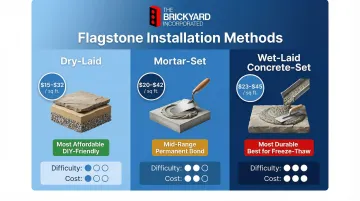
Dry-Laid ($15–$32/sq ft installed):Stones are set on a compacted sand or gravel base and secured with polymeric sand. This is the most affordable option and the easiest to adjust if stones shift over time. A practical choice for DIY-friendly projects and areas with moderate freeze-thaw cycles.
Mortar-Set ($20–$42/sq ft installed):Stones are bonded with mortar over an existing hard surface like an old concrete patio. This method is more stable and durable than dry-laid, offering mid-range pricing. Works well where a permanent bond is needed but a full concrete pour isn't warranted.
Wet-Laid/Concrete-Set ($23–$45/sq ft installed):Stones are placed over freshly poured concrete, creating the strongest and most durable bond. This is the most labor-intensive and expensive method, but it delivers maximum stability and longevity. The right call for high-traffic areas or Wisconsin-style winters with heavy freeze-thaw stress.
Cost by Stone Type
The type of flagstone you select is one of the biggest material cost variables. Common options include sandstone, limestone, slate, quartzite, and bluestone, each priced differently based on natural availability and how far the stone travels from quarry to job site.
Material Cost by Stone Type:
| Stone Type | Cost per Ton | Cost per Sq Ft (Materials) |
|---|---|---|
| Sandstone | $200–$350 | $9–$13 |
| Limestone | $250–$400 | $7–$15 |
| Bluestone | $375–$450 | $6–$14 |
| Quartzite | $400–$450 | $7–$25 |
| Slate | $475–$700 | $9–$25 |
Locally sourced stones cost less than those shipped from distant quarries. Transportation accounts for 50–70% of the final delivered cost of aggregates, giving the Midwest a real cost advantage thanks to abundant local deposits and shorter haul distances. Limestone, for instance, is often more affordable in the Milwaukee area than in coastal markets.
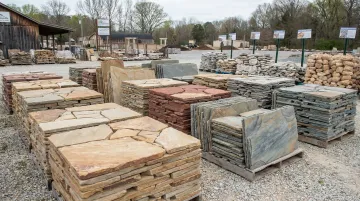
The Brickyard in Milwaukee stocks a broad selection of natural stone paving products, including reclaimed flagstone that can reduce material costs while adding character. Seeing slabs side by side at a local distributor makes it easier to gauge thickness, color variation, and quantity before purchasing.
Key Factors That Affect the Cost of a Flagstone Patio
Beyond the base price of stone and labor, several technical and project-specific factors routinely shift total costs. Knowing which ones apply to your project before you get quotes puts you in a much stronger position.
Patio Size and Layout Complexity
Larger patios naturally cost more, but irregular shapes, curved edges, and detailed patterns add cutting time and waste. A rectangular patio is always cheaper per square foot than a freeform organic shape. Complex layouts require more labor hours for stone cutting, fitting, and adjustments — driving up the final bill.
Stone Thickness and Quality
Flagstone should be at least 1.5 inches thick for patios (2+ inches for walkways) to prevent cracking under furniture and foot traffic. Thicker, higher-quality stones cost more per square foot but reduce the risk of cracking during and after installation. Thin or low-grade stones may save money upfront but often lead to costly repairs down the road.
Labor and Location
Labor typically accounts for $11–$15 per square foot of the installed price, though complex designs can push labor to $15–$25 per square foot. Regional labor market differences matter significantly.
Regional Cost Comparison for a 200 sq ft Patio:
- Milwaukee, WI: $3,556
- Richmond, VA: $3,000
- Los Angeles, CA: $3,930
- New York City, NY: $5,245
Milwaukee-area projects are priced significantly lower than coastal markets like New York or Los Angeles, reflecting regional labor and sourcing advantages.
Site Preparation and Demolition
If an existing patio needs to be demolished and hauled away before installation, this adds significant cost. Concrete removal costs $1,000–$3,000 per project, with urban areas sometimes reaching $6–$14 per square foot for demolition.
Grading, drainage adjustments, or difficult site access can also increase labor hours:
- Yard leveling/grading: $1–$2 per sq ft
- French drain installation: $10–$50 per linear foot
- Trench/channel drain: $30–$150 per linear foot
Seasonality and Timing
Site prep costs are largely fixed, but timing your installation can soften the labor side of the bill. Scheduling a flagstone patio installation in early spring (before peak demand) or late fall typically yields lower labor rates than summer. In Milwaukee, the ground typically freezes by December, making late March through May the most practical window for locking in off-peak rates before contractor schedules fill up.
Full Cost Breakdown of a Flagstone Patio
Stone is just the starting point. A realistic flagstone patio budget covers five distinct cost categories — some paid once, others recurring over the life of the patio.
| Cost Category | Frequency | Typical Range |
|---|---|---|
| Flagstone materials | One-time | $2–$15+ per sq ft |
| Base preparation | One-time | $2–$5 per sq ft installed |
| Labor and installation | One-time | $11–$25 per sq ft |
| Sealing and maintenance | Every 18–36 months | $0.80–$2.50 per sq ft |
| Repairs and replacement | As needed | $3–$30 per sq ft |
Flagstone materials vary by stone type, thickness, and how far it's shipped. Bluestone and slate sit at the lower end; imported travertine or irregular fieldstone push toward $15+ per sq ft.
Base preparation depends on your installation method. A standard dry-laid patio needs a compacted 4–10 inch gravel base, with gravel running $10–$50 per ton. Wet-laid or mortar-set installations add concrete to that cost.
Labor covers excavation, leveling, stone cutting, placement, grouting, and cleanup. Standard dry-laid work runs $11–$15 per sq ft. Complex patterns, sloped sites, or mortar-set methods push labor to $15–$25 per sq ft.
Sealing protects flagstone from staining and moisture intrusion. Professional sealing costs $300–$550 per project, or roughly $0.80–$2.50 per sq ft. Budget for annual cleaning at $0.35–$0.77 per sq ft as well.
Repairs become necessary when stones crack, chip, or shift. Repair costs range from $3–$30 per sq ft depending on damage severity. Addressing problems early prevents structural issues like drainage failure and base erosion from compounding the cost.
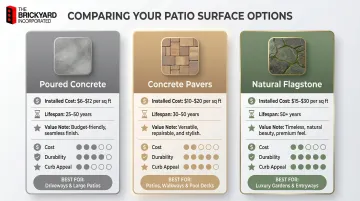
Flagstone vs. Concrete vs. Pavers: What's the Cost Difference?
Flagstone is generally the most expensive of the three common patio surface options, though durability, aesthetics, and long-term value shift that picture considerably.
Installed Cost Comparison:
| Surface Type | Installed Cost per Sq Ft | Lifespan |
|---|---|---|
| Poured Concrete | $4–$30 | 25–50 years |
| Concrete Pavers | $8–$25 | Up to 100 years |
| Natural Flagstone | $15–$32 | 10–100+ years |
Key Trade-Offs:
- Concrete costs less upfront but offers limited design flexibility and a uniform look
- Pavers balance variety with easy individual-unit replacement and long lifespans
- Flagstone carries the highest upfront cost but delivers natural aesthetics and strong resale value
Flagstone's long lifespan, low maintenance requirements, and curb appeal make it the most cost-effective choice over a 10–20 year horizon for homeowners focused on resale value. Hardscaping investments like patios recoup an average of 46% of their cost at resale — a return that concrete rarely matches on its own.
How to Budget Smarter for Your Flagstone Patio
National averages only go so far. A realistic flagstone budget starts with your specific project details. Before requesting quotes, pin down these key inputs:
- Desired patio size and shape
- Preferred stone type
- Installation method
- Site conditions
- Whether demolition of an existing surface is needed
Practical Cost-Saving Strategies:
- Choose a locally sourced stone to minimize transportation costs — sandstone and limestone are often most affordable in the Midwest
- Opt for a simpler rectangular layout to reduce cutting labor
- Avoid adding stone steps or retaining walls to the initial scope if budget is tight
- Purchase materials directly from a hardscape supplier rather than through a contractor. Local distributors like The Brickyard let homeowners and contractors in the Milwaukee area compare stone types and quantities firsthand before committing
Even with a solid strategy, certain missteps can quietly derail your budget. Watch out for these:
Common Budgeting Mistakes to Avoid:
- Focusing only on the per-square-foot stone price without accounting for labor, base preparation, and sealing
- Choosing the lowest-bid contractor without verifying experience with natural stone
- Underestimating the size of the finished patio relative to the actual outdoor space
Frequently Asked Questions
How much does a 20×20 flagstone patio cost?
A 400 sq ft flagstone patio typically costs between $6,000 and $12,800 fully installed. The final price depends on stone type, installation method, and local labor rates — wet-laid installations with premium stone will be at the higher end.
How much would 1,000 sq ft of flagstone patio labor cost?
Using the standard labor range of $11–$15 per square foot, labor for a 1,000 sq ft patio would be $11,000–$15,000. Larger projects may see slightly lower per-square-foot labor rates due to efficiency, though site complexity or wet-laid installation can push costs higher.
Is flagstone more expensive than concrete?
Yes, flagstone costs more than poured concrete per square foot. That said, flagstone delivers natural texture, long-term durability, and curb appeal that poured concrete typically can't match at any price.
What is the cheapest type of flagstone?
Sandstone and limestone are typically the most affordable flagstone options, especially in regions where they are locally sourced. Bluestone and quartzite tend to be pricier due to limited regional availability and higher demand.
How long does a flagstone patio last?
A properly installed and maintained flagstone patio can last 25 years or more. Periodic sealing and prompt repair of cracked or shifted stones are the main upkeep tasks.
Can I install a flagstone patio myself to save money?
DIY installation is possible for smaller, dry-laid patios. Proper grading, leveling, and stone cutting all require experience. Errors in base preparation can lead to shifting, pooling water, or cracked stones that end up costing more to fix than hiring a pro from the start.
![How Much Does a Concrete Driveway Cost? [2026 Data]](https://file-host.link/website/thebrickyardwi-ie8696/assets/blog-images/739cc277-5d64-4828-9270-a102416927f6/1773750851050546_501e13ada9cf4d2fae6b977ce0847b69/1080.webp)