Introduction
Most Milwaukee homeowners planning a landscape project struggle with the same question: do you need a "brick wall" or a "retaining wall"? They're not competing options — they describe two different classification systems entirely.
The distinction comes down to function vs. material. A retaining wall is defined by what it does — holding back soil and resisting lateral earth pressure. A brick wall is defined by what it's made of: fired clay or concrete units laid in mortar. Brick can absolutely be used to build a retaining wall, provided it's properly engineered for that purpose.
This article clarifies the definitions, structural differences, cost implications, and practical guidance you need to choose the right wall type for your Milwaukee-area project.
TL;DR
- Brick walls are masonry structures valued for aesthetics, boundary definition, and architectural character
- Retaining walls hold back soil and prevent erosion — they're defined by function, not material
- A retaining wall can be built from brick, but not all brick walls can safely retain soil
- Retaining walls require drainage systems and often engineering review; brick walls focus on appearance
- Clay brick's strength advantage over concrete block can allow for slimmer, more refined retaining wall profiles
Brick Walls vs. Retaining Walls: At a Glance
| Feature | Brick Wall | Retaining Wall |
|---|---|---|
| Primary Purpose | Aesthetics, boundaries, architectural detailing | Soil retention, erosion control, grade management |
| Typical Materials | Fired clay brick, concrete brick | Segmental concrete units, clay brick, natural stone, timber, gabion |
| Structural Focus | Vertical loads, architectural integrity | Lateral earth pressure resistance |
| Drainage Requirements | Minimal to none | Mandatory gravel backfill, weep holes, drainage pipe |
| Installation Complexity | Skilled masonry craftsmanship | Excavation, engineered footing, drainage systems, possible permits |
| Best Use Cases | Garden borders, patio walls, driveway pillars, decorative features | Sloped terrain, terraced gardens, erosion prevention, level outdoor spaces |
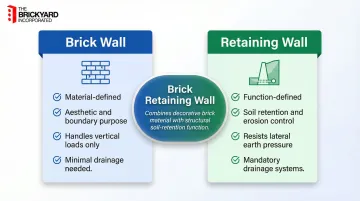
These categories aren't mutually exclusive. A brick retaining wall sits at their intersection, built to resist lateral earth pressure while delivering the visual appeal of traditional masonry — it has to satisfy the structural demands of a retaining wall and the aesthetic standards of finished brickwork.
What Is a Brick Wall?
A brick wall is a masonry structure constructed from fired clay or concrete bricks laid in mortar. These walls serve primarily aesthetic and boundary functions—garden borders, patio enclosures, driveway pillars, outdoor fireplace surrounds, and architectural detailing on buildings.
Brick walls hold up well over time and fit a wide range of design styles:
- Timeless visual appeal that complements traditional, transitional, and modern architectural styles
- Low maintenance once installed, requiring only occasional mortar repointing
- Fire resistance with assemblies routinely achieving 1-2 hour fire ratings
- Compatibility with period restoration projects when matched correctly
That said, brick walls have a real structural boundary worth understanding. Standard brick walls are not engineered to resist lateral soil pressure — they handle vertical loads and aesthetic purposes, not slope stabilization or earth retention.
Use Cases of Brick Walls
Common applications where brick walls excel:
- Garden feature walls and raised planter borders
- Patio and courtyard enclosures
- Outdoor kitchen and fireplace surrounds
- Driveway entrance pillars
- Facade detailing and architectural accents
- Property boundary markers
In these contexts, brick walls are about curb appeal and visual cohesion with existing structures—not managing soil movement or grade changes.
The Brickyard stocks reclaimed brick, thin brick, and standard clay brick, making it straightforward to find the right match for new builds and period-accurate restoration projects alike.
What Is a Retaining Wall?
A retaining wall is a structure specifically engineered to hold back soil, manage grade changes, and prevent erosion on sloped or uneven terrain. The defining feature is its ability to resist lateral earth pressure—the horizontal force exerted by soil trying to slide downward.
Material Options for Retaining Walls
Retaining walls can be constructed from multiple materials, each with different strength, drainage, and aesthetic profiles:
- Segmental concrete units (SRW) dominate residential use, holding approximately 65% of market share — dry-stacked and gravity-reliant, often reinforced with geogrid
- Clay brick, when properly reinforced and drained, delivers superior compressive strength and cleaner aesthetics than most alternatives
- Natural stone is a premium option with 8.1% annual growth in demand, prized for how naturally it integrates with surrounding landscapes
- Gabion baskets — wire mesh cages filled with stone — offer excellent permeability and are particularly effective for erosion control
- Timber is a lower-cost choice, though it carries a shorter lifespan in Wisconsin's freeze-thaw climate
The Critical Role of Drainage
Without proper water management, retaining walls fail — and often without warning.
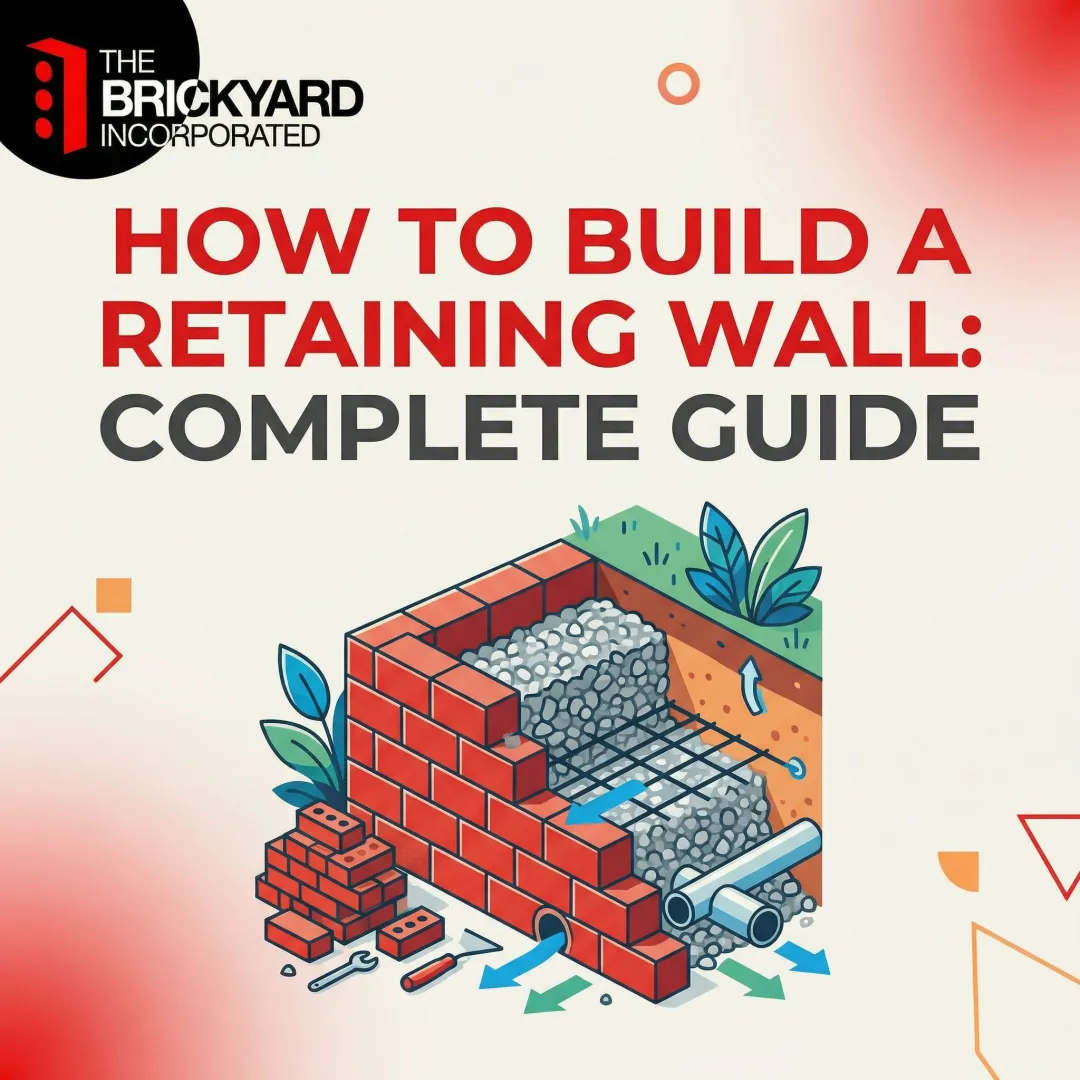
When water accumulates behind a wall, it creates hydrostatic pressure that can double or triple the lateral load, causing the wall to lean, crack, or collapse entirely. Proper drainage requires:
- At least 12–24 inches of clean gravel (AASHTO #57 stone) as backfill directly behind the wall
- A 4-inch perforated drain pipe at the base of the gravel fill, sloped to daylight
- Weep holes in mortared brick walls every 24 inches on center along the bottom course
- Geotextile fabric to keep soil from migrating into the drainage gravel
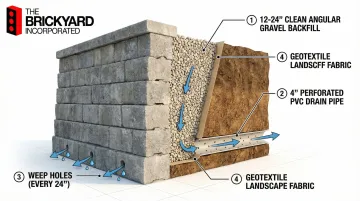
Research shows that proper drainage reduces frost heave stresses to just 1/7th of what undrained walls experience—critical for Milwaukee's freeze-thaw cycles.
Engineering and Permit Requirements
For walls taller than certain heights, engineering review is typically required. In Southeastern Wisconsin:
- City of Milwaukee: Walls supporting 32+ inches of unbalanced fill require permits
- South Milwaukee: Walls exceeding 3 feet require professional design
- New Berlin: Walls over 16 inches need Administrative Use Approval; walls exceeding 48 inches require professional engineering
Always verify local Department of Neighborhood Services (DNS) codes before finalizing designs.
Clay Brick's Structural Advantage
Those permit thresholds are driven by load — which is exactly where material choice becomes critical. Standard clay brick achieves compressive strengths of 8,250–11,500 psi, compared to the 3,000 psi minimum required for standard concrete masonry units (CMU).
Because of clay brick's superior density and bending strength, a concrete block retaining wall stem must be approximately 50% thicker than a clay brick stem to achieve equivalent capacity. For properties with tight lot lines, this allows brick walls to maximize usable yard space.
Use Cases of Retaining Walls
Scenarios that require retaining walls:
- Terraced garden beds on slopes
- Preventing soil erosion near driveways or walkways
- Creating level outdoor living areas on hillside lots
- Managing stormwater runoff patterns
- Stabilizing slopes adjacent to structures
Retaining walls often double as landscape design features, particularly when built with brick, natural stone, or textured segmental units that add visual character while serving a structural purpose.
Brick Walls vs. Retaining Walls: Key Differences
Structural Purpose
Brick walls resist vertical loads—their own weight plus any architectural elements they support. They're designed for compression, not lateral forces.
Retaining walls resist lateral (horizontal) earth pressure. That single difference drives every decision downstream: how the wall is footed, how it's backfilled, and whether it needs steel reinforcement or just mass to resist overturning.
Material Strength Requirements
When brick is used in a retaining wall, the wall must be much thicker or reinforced compared to a standard decorative brick wall. The lateral load demands are simply different from anything a purely decorative wall faces.
Clay brick's 2.5–3× higher compressive strength compared to concrete block means it can handle greater loads in a thinner profile—but only when properly engineered with reinforcement, solid grouting, and a footing deep enough to stay below frost line.
Drainage
Decorative brick walls generally don't require engineered drainage systems. They're exposed to air on both sides and don't trap water.
Retaining walls—regardless of material—must account for water management. Without it, hydrostatic pressure builds behind the wall until it cracks, tilts, or fails outright.
Installation Complexity and Cost
Brick walls are labor-intensive due to the mortar-setting process and smaller unit size. Complexity centers on skilled craftsmanship—level courses, consistent joints, proper tooling.
Retaining walls add layers of complexity:
- Excavation to proper depth
- Concrete footing below frost line (48 inches minimum in Wisconsin)
- Compacted gravel base
- Drainage pipe installation
- Backfill with proper compaction
- Engineering review for taller walls
Cost drivers differ across three areas:
| Cost Factor | Brick Walls | Retaining Walls (SRW) |
|---|---|---|
| Materials | Clay brick and natural stone carry higher upfront costs | Segmental concrete units are generally less expensive |
| Labor | Requires skilled masons for mortar work | General hardscape crews can install most SRW systems |
| Foundation | Poured concrete footing required | Crushed-stone leveling pad typically sufficient |
Maintenance
Brick walls need occasional repointing of mortar joints—typically every 20–30 years depending on exposure and mortar quality. Otherwise, they're low-maintenance.
Retaining walls require periodic inspection of drainage systems, especially after heavy rainfall or freeze-thaw cycles. Milwaukee's climate makes this critical—trapped water that freezes expands by approximately 9%, creating pressure that can crack or displace even well-built walls.
When to Use a Brick Wall vs. a Retaining Wall
Choose a Brick Wall When:
- The primary goal is aesthetics or boundary definition
- The site is relatively flat with no grade change
- The wall doesn't need to support significant soil load
- Design coherence with existing brick architecture is a priority
- You want a decorative garden border, patio enclosure, or architectural feature
Choose a Retaining Wall When:
- The property has a slope or grade change requiring stabilization
- Soil erosion is a current or future concern
- You need to create a level usable outdoor space on sloped terrain
- Local drainage patterns push water toward structures
- You're terracing a hillside for garden beds or outdoor living areas
Choose a Brick Retaining Wall When:
You want the structural performance of a retaining wall with the aesthetic quality of traditional brick—particularly for visible front-yard or patio-adjacent walls under approximately 3 feet in height.
This approach requires:
- Proper concrete footing below the 48-inch frost line
- Steel reinforcement and solid grouting
- Gravel backfill and drainage pipe
- Weep holes every 24 inches
- Material rated for moisture exposure
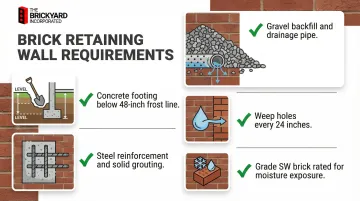
For retaining applications in Wisconsin, material selection matters. Grade SW (Severe Weathering) brick is the required standard for exterior use in harsh freeze-thaw climates. The Brickyard stocks Grade SW brick and can help you confirm the right spec for your specific project.
Decision Framework
Ask yourself these questions:
Is the wall facing soil on one side? → Retaining wall required
Is the wall a standalone feature in a flat yard? → Brick wall appropriate
Is the wall both decorative and partially terracing a slope? → Engineered brick retaining wall
Will the wall be exposed to road salt or de-icing chemicals? → Specify materials passing ASTM C1262 saline freeze-thaw testing
Climate-Specific Considerations for Milwaukee
Wisconsin's freeze-thaw cycles exploit any drainage weakness in retaining walls and cause mortar deterioration in brick walls. Getting either wall type right in this climate comes down to two non-negotiables: drainage and footing depth.
The Wisconsin Administrative Code mandates footings at minimum 48 inches below grade to prevent frost heave. Beyond that, use Grade SW brick, a high-quality freeze-thaw mortar, and gravel backfill that keeps water moving away from the wall face year-round.
Frequently Asked Questions
Can a brick wall be used as a retaining wall?
Yes, brick can build a retaining wall, but the wall must be specifically engineered for that purpose. This means proper concrete footing below the frost line, steel reinforcement, drainage systems, and sufficient thickness to resist lateral soil pressure—unlike a standard decorative brick wall.
What is the main difference between a brick wall and a retaining wall?
A brick wall is defined by its material (clay brick) and typically built for aesthetics or boundary purposes. A retaining wall is defined by its function (holding back soil) and can be made from brick, concrete block, natural stone, or other materials.
How tall can a brick retaining wall be without a permit?
Permit thresholds vary by location. In Milwaukee, walls supporting 32+ inches of unbalanced fill require permits. South Milwaukee requires professional design for walls exceeding 3 feet. Always check with local building authorities before construction.
Which is stronger for retaining soil — brick or concrete block?
Clay brick has superior compressive and bending strength compared to standard concrete block, so a brick retaining wall stem can be roughly 50% thinner than an equivalent concrete block wall—though both materials still require proper reinforcement and drainage to perform correctly.
Do retaining walls need drainage systems?
Yes, drainage is essential for all retaining walls regardless of material. Without it, water accumulates behind the wall, creating hydrostatic pressure that can cause leaning, cracking, or total wall failure.
What is the best material for a retaining wall in cold climates like Milwaukee?
For Wisconsin's climate, choose materials rated for freeze-thaw durability: Grade SW clay brick, natural stone, or engineered segmental retaining wall units are all solid options. Proper drainage installation is just as important to prevent frost heave damage.