
Introduction
Many homeowners face the frustration of watching their driveway gravel scatter across the lawn after the first heavy rain or a few passes of the car. It's not inevitable. It's a material selection and installation problem. The culprit is almost always the wrong type of gravel: smooth, rounded stones that act like ball bearings under tire pressure, rolling freely instead of locking together.
Not all gravel behaves the same way. The shape and texture of the stones determine whether they lock into a stable surface or scatter with every vehicle pass. Choosing angular crushed stone from the start—paired with proper installation—cuts down on maintenance and eliminates the need for constant raking and topping up. This guide covers the best gravel types for a driveway that stays put, plus the key installation factors that make the difference.
TLDR
- Angular crushed stone (crusher run, #57 stone, crushed granite, crushed limestone) resists movement far better than smooth rounded stones
- Choose gravel by particle shape and compaction potential — not looks — for long-term stability
- Proper sub-base, edging, and adequate depth prevent shifting as much as the gravel type itself
- Crushed angular stone with fine particles is the top choice for Milwaukee driveways facing freeze-thaw cycles
Why Gravel Moves — and What Stops It
Rounded stones act like ball bearings, rolling freely against each other under tire pressure and gravity. Angular crushed stones, by contrast, have jagged, irregular edges that mechanically interlock and resist lateral movement.
Two main forces cause gravel to shift:
- Vehicle traffic — Horizontal force from turning tires pushes rounded gravel outward, especially near garage entrances and turnarounds
- Water and slope — Gravity pulls loose stone downhill during rain or snowmelt, washing material into surrounding areas
In Wisconsin, freeze-thaw cycles amplify both of these forces. Water penetrates between loose rounded stones, freezes, and heaves the surface upward. Angular stone compacted with fine particles minimizes these gaps and resists frost heaving more effectively than clean, open-graded gravel.
Best Gravel Types for a Driveway That Won't Move
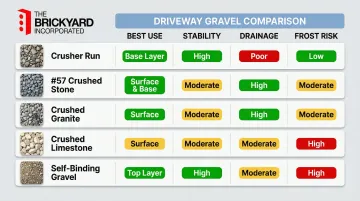
The top-performing driveway gravels share four traits: stability under vehicle traffic, resistance to spreading, excellent drainage, and suitability for Midwest climates. All are angular, crushed stone products.
| Gravel Type | Best Use | Stability | Drainage | Frost Risk |
|---|---|---|---|---|
| Crusher Run | Base layer or full surface | Highest — compacts like concrete | Moderate | Low |
| #57 Crushed Stone | Top layer over base | High with proper base | Excellent | Very low |
| Crushed Granite | Base or top layer | Very high | Good | Low |
| Crushed Limestone | Base or top layer | High | Good | Low |
| Self-Binding Gravel | Decorative/low-traffic only | Moderate | Poor | Very high |
Crusher Run (Quarry Process / #411 Gravel)
Crusher run is a blend of crushed stone pieces ranging from ¾ inch down to stone dust. This graduated particle mix compacts into an extremely dense, almost concrete-like layer widely regarded as the most stable gravel surface for driveways.
The fine particles bind the larger stones together when compacted and moistened, making it exceptionally resistant to movement. Crusher run achieves 85-95% compaction and can reach compressive strengths exceeding 10,000 psi, making it the go-to base layer material. It can also function as a top surface. For residential driveways, a compacted depth of 4-6 inches of crusher run provides excellent load-bearing capacity.
#57 Crushed Stone
#57 stone is uniformly sized angular crushed rock (roughly ¾ inch), commonly limestone or granite. It drains exceptionally well and provides a clean, finished appearance for a driveway top layer.
While it lacks the binding fines of crusher run, the angular edges still interlock well enough to resist significant movement under normal residential traffic. It's best used as a 2-3 inch top layer over a compacted crusher run base. With no fines in the mix, water drains instantly through the voids, eliminating frost heave potential.
Crushed Granite
Crushed granite is one of the hardest, most durable driveway aggregate options. Its igneous rock composition resists breakdown from heavy loads and harsh weather, and its angular fracture creates sharp interlocking edges that hold position well.
It works well for both base and top layers. A ¾-inch size is typical for top layers — the gray or pinkish tones give driveways a clean, finished look without sacrificing stability.
Crushed Limestone
Crushed limestone is a widely available, cost-effective angular crushed stone that compacts well and performs reliably as a driveway surface. Its pale, clean coloring is popular for residential curb appeal.
Limestone is slightly softer than granite and may degrade more quickly under very heavy traffic over many years. For standard residential driveways, however, it's an excellent, stable choice. Its availability as a local material in many Midwest regions makes it a budget-friendly option.
Self-Binding Gravel
Self-binding gravel is a specialized mix of gravel, sand, and clay that, when compacted and wetted, forms a firm, semi-solid surface. It significantly reduces loose stone movement compared to standard top-dressing gravel.
It's appealing for homeowners who want the gravel look without constant raking. That said, it's best suited for lower-traffic or decorative driveways only. The clay content that gives self-binding gravel its strength also traps water, making it highly susceptible to frost heave in climates like Wisconsin. During spring thaw, the clay binder turns into lubricating mud, causing severe rutting under vehicle loads. Avoid clay-heavy self-binding gravels for primary residential driveways in the Upper Midwest.
How to Keep Gravel from Moving: Installation Tips
Proper installation matters as much as gravel type. Even the best angular stone will shift without correct preparation.
Excavation and Sub-Base Preparation
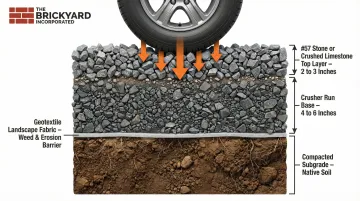
Dig to an appropriate total depth before any gravel is placed. Residential driveways require a minimum total compacted depth of 6-8 inches for standard passenger vehicles. On weak clay subgrades common in Wisconsin, increase the total depth to 10-12 inches to ensure adequate load distribution and frost protection. Lay and compact a base layer of crusher run or compacted fill before any decorative top layer goes down.
Geotextile Landscape Fabric
Laid over the excavated ground before any gravel is placed, geotextile fabric prevents weed intrusion, stops gravel from sinking into soft soil, and helps maintain surface stability over time. In Wisconsin's clay-heavy soils, skipping this step often leads to gravel gradually mixing into the subgrade — producing a muddy, rutted surface within a few seasons.
Edging
Using metal landscape edging, timber, concrete curbing, or paver borders physically contains the gravel and prevents lateral spreading at the driveway margins. Without a hard border, even well-compacted gravel migrates into lawn edges over time — especially on curved driveways. Concrete curbing and paver edging from The Brickyard are common choices for Milwaukee-area homeowners who want a clean, durable border that holds up through freeze-thaw cycles.
Layered Approach
A compacted base layer (4-6 inches of crusher run or #411) topped with a finish layer of 2-3 inches of #57 stone or crushed limestone produces a stable, well-draining surface. The dense base bears vehicle loads while the open-graded top layer sheds water rather than pooling it — reducing both freeze damage and surface erosion.
Ongoing Maintenance
Regular maintenance—occasional raking to redistribute displaced stone, and topping up every few years to replace compacted or lost material—extends the driveway's useful life and reduces the volume of stone you'll need to replace. Gravel driveways on slopes benefit from gravel grid systems that create honeycomb cells to lock stone in place, preventing downhill migration during heavy rain.
How to Choose the Right Gravel for Your Driveway
Three primary factors determine the best gravel for your specific situation:
Traffic Volume:
- Heavy daily use needs crusher run base plus angular top layer
- Light residential use allows more flexibility
- Occasional vehicle access can use thinner layers
Slope:
- Angular stone is mandatory on any incline
- Gravel grids are essential for steep slopes
- Flat driveways have more material options
Climate:
Freeze-thaw regions like Wisconsin require well-compacted angular stone with minimal voids to resist frost heaving. Avoid clay-heavy self-binding gravels here — crusher run and #57 stone combinations handle Wisconsin winters far better.
Clean vs. Modified Gravel:
Knowing which type you're ordering matters:
- Clean gravel — uniform-sized stones with good drainage but lower compaction; best for top layers
- Modified gravel — mixed sizes with fines added for excellent compaction and stability; best for base layers
Ask your supplier which type you're getting before you order.
Once your base is sorted, the top layer is where appearance comes in. Crushed limestone and crushed granite both deliver stability with a clean, finished look. Keep crusher run as a base layer beneath a more decorative top stone — it does its best work out of sight.
Conclusion
The best gravel for a driveway that doesn't move is angular crushed stone—specifically crusher run for the base and #57 stone, crushed granite, or crushed limestone for the top layer. Pair these materials with proper sub-base preparation, geotextile fabric, and edging to create a stable surface that resists shifting under vehicle traffic and Wisconsin's harsh freeze-thaw cycles.
Milwaukee-area homeowners and contractors can find crushed stone, pavers, and hardscape supplies at The Brickyard, located at 3352 S. Clement Ave. in Milwaukee. The staff can help you match the right stone grade and base material to your project—whether you're laying a new driveway or stabilizing an existing one. They're open Monday through Friday, 7AM–4PM.
Frequently Asked Questions
What is the best gravel for a driveway that doesn't move?
Angular crushed stone—specifically crusher run for the base and ¾-inch crushed stone (granite or limestone) for the top layer—is the most stable option. The jagged edges lock together under vehicle weight, while smooth rounded stones roll and scatter under the same pressure.
How do I keep my gravel from moving on my driveway?
Four steps make a real difference:
- Choose angular crushed stone over rounded gravel
- Install a compacted sub-base before adding top material
- Add landscape edging along both sides to contain spread
- Lay geotextile fabric beneath the gravel to prevent sinking and weed growth
Top up the depth periodically as material compacts or shifts over time.
What size gravel is best for a driveway?
¾-inch angular crushed stone is the most widely recommended size for driveway top layers—large enough not to get lodged in tire treads, small enough to compact and interlock. Crusher run (mixed sizes down to dust) is ideal for base layers.
Is pea gravel good for driveways?
Pea gravel is not recommended for driveways because its smooth, rounded shape causes it to roll under tire pressure, scatter onto surrounding areas, and provide poor traction. Angular crushed stone performs significantly better.
How deep should gravel be on a driveway?
A properly built gravel driveway requires 6–8 inches total depth. That breaks down as 4–6 inches of compacted crusher run or processed gravel for the base, plus a 2–3 inch finish layer on top. Weak clay subgrades may require 10–12 inches total.
Does crushed limestone work well for driveways?
Crushed limestone is an excellent driveway material—it is angular, compacts well, drains properly, and offers good stability for residential traffic. It is slightly softer than granite but highly cost-effective and widely available in the Midwest.


![How Much Does a Concrete Driveway Cost? [2026 Data]](https://file-host.link/website/thebrickyardwi-ie8696/assets/blog-images/739cc277-5d64-4828-9270-a102416927f6/1773750851050546_501e13ada9cf4d2fae6b977ce0847b69/1080.webp)