Introduction
A beautiful yard or garden doesn't disappear when the sun sets—the right outdoor landscape lighting keeps it alive, extends usable hours, and creates a striking nighttime atmosphere that boosts curb appeal and property value. According to the National Association of Realtors' 2023 Remodeling Impact Report, landscape lighting earns a perfect 10/10 "Joy Score" from homeowners, with 68% reporting a greater desire to be home after installation.
That satisfaction makes sense — good lighting does more than look beautiful. It guides guests safely through a property, deters trespassers, and makes patios and walkways usable well into the evening. This guide covers 15 specific design ideas to help homeowners and contractors transform outdoor spaces after dark.
TLDR
- Uplighting, pathway lights, hardscape lighting, and string lights each solve a different outdoor need — from safety to ambiance
- Low-voltage LED fixtures are the most energy-efficient choice, using 75-90% less energy than halogen bulbs
- Layering accent, task, and ambient lighting creates depth and visual interest — the difference between a flat yard and a finished outdoor space
- Retaining walls, trees, pergolas, and pathways can all be lit to boost curb appeal long after sunset
What Makes Outdoor Landscape Lighting So Transformative?
Landscape lighting extends the usability of outdoor spaces well into the evening. In Wisconsin, where warm seasons are short, that matters. Properly lit patios, decks, and walkways let homeowners use their outdoor investment from dusk until late night — not just on weekends, but on any given Tuesday.
Beyond aesthetics, landscape lighting delivers measurable practical benefits:
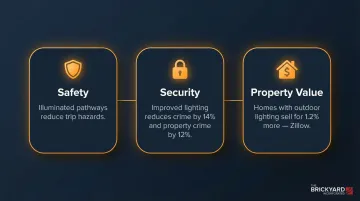
- Enhanced safety: Illuminated pathways and stairs reduce trip hazards and help guests navigate unfamiliar terrain
- Security deterrence: Research shows that improved lighting reduces total crime by 14% and property crime by 12%
- Increased property value: Zillow data indicates homes with outdoor lighting sell for 1.2% more than comparable homes without it
A 2021 National Association of Home Builders study found that 87% of homebuyers rate exterior lighting as "essential or desirable" — putting it on par with updated kitchens and finished basements as a purchase driver.
Accent & Feature Lighting Ideas (Ideas 1–5)
Idea 1: Tree Uplighting
Ground-mounted spotlights angled upward at the base of trees create dramatic shadows and highlight canopy texture. Large, statement trees like oaks or maples work best here — the more distinctive the branching pattern, the more striking the nighttime result.
Placement tips:
- Position fixtures 2-4 feet from the trunk base
- Angle lights at 30-45 degrees for the most natural-looking effect
- Use warm white (2700K–3000K) LEDs to avoid harsh, unnatural glow
- For tall, narrow trunks, choose 10-15° narrow spot beams; for broad canopies, use 60° wide floods positioned further away
Idea 2: Architectural Spotlight Lighting
Directional spotlights or floodlights aimed at a home's facade — columns, stone accents, brick walls, or gable ends — highlight architectural character and dramatically increase curb appeal at night. Even modest exteriors become focal points after dark.
Grazing technique for texture
Place fixtures 6-8 inches from the wall surface at a steep angle. Skimming light parallel across brick or stone creates high-contrast shadows that reveal depth and texture, making masonry exteriors particularly impressive at night.
Idea 3: Silhouette & Shadow Lighting
Create dramatic visual effects using two related techniques:
- Silhouette lighting: Place the light source behind a plant or object (between it and a wall or fence) to cast a dramatic shadow outline onto the surface
- Shadow lighting: Position the light in front of a plant to project its shadow onto a surface behind it
Ornamental grasses, Japanese maples, and sculptural shrubs all have the distinctive forms that make these effects worth the effort.
Idea 4: Moonlighting (Overhead Downlighting)
Moonlighting places fixtures high in trees or on tall structures, angling them downward to mimic natural moonlight filtering through branches. The result is one of the softest, most romantic effects in outdoor lighting.
Installation guidelines:
- Mount fixtures 20-25 feet high in tree canopies
- Use 60° wide beam spreads aimed downward
- Use tree-mount junction boxes with standoff screws to allow growth without choking the tree
- Combine multiple moonlights to create overlapping pools of soft illumination
Idea 5: Garden Bed & Flowerbed Lighting
Low-profile accent lights or in-ground well lights placed within garden beds illuminate seasonal plantings, ornamental grasses, or sculpted shrubs from below. Placed thoughtfully, these lights draw the eye along bed edges and keep your planting design visible long after sunset.
Quick placement tips:
- Use 100-200 lumen fixtures to highlight color and texture without overpowering delicate plants
- Space fixtures at irregular intervals to avoid a runway effect
- Focus on plants with strong forms — ornamental grasses, coneflowers, or tall perennials respond especially well
Pathway, Safety & Hardscape Lighting Ideas (Ideas 6–10)
Idea 6: Pathway & Walkway Lighting
Low-mounted path lights staggered in an alternating pattern (rather than lined up symmetrically on both sides) create a natural, flowing look. Space fixtures every 6-8 feet for even illumination without creating a harsh "runway" effect.
Safety function: Illuminated walkways reduce trip hazards and help guests navigate unfamiliar terrain at night, making this a high-priority addition for any property. Industry standards recommend 100-200 lumens per path light to provide adequate visibility without glare.
Idea 7: Step & Staircase Lighting
Recessed step lights or riser lights built into outdoor staircase faces provide both safety and elegant definition. Low-level lighting here is sufficient—bright lights aimed upward from steps can create glare and actually reduce visibility.
Mount fixtures directly into stair risers or beneath tread overhangs, using 150-300 lumens to clearly define each step edge without overwhelming the area.
Idea 8: Retaining Wall & Paver Lighting
Low-voltage fixtures recessed into or mounted beneath retaining wall caps, or placed along paver edges, cast a soft horizontal glow that emphasizes the geometry and texture of hardscape features after dark.
This technique is especially impactful for properties with layered retaining walls or decorative paver patios, turning functional structures into nighttime focal points. For Milwaukee-area homeowners, The Brickyard stocks low-voltage lighting products alongside pavers, retaining wall systems, and masonry materials—so you can select and match your hardscape and lighting in one visit.
Idea 9: Driveway Lighting
Bollard lights, low post lights, or in-ground marker lights along driveway edges define the vehicle path clearly at night while adding a polished, estate-like look to the front of the property. This prevents vehicles from drifting onto lawns or garden beds and creates a welcoming approach for guests.
For consistent edge definition, space fixtures 8-12 feet apart along both sides of the drive. Bollards work especially well on wider driveways where low path lights might get lost against the pavement scale.
Idea 10: Security & Motion-Sensor Lighting
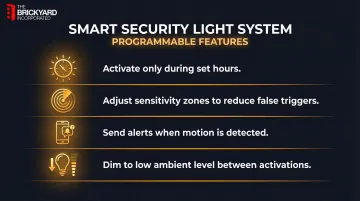
Not all outdoor lighting is purely decorative — security lighting serves a different purpose. Motion-activated floodlights or smart security lights placed at entry points, corners, and dark perimeter areas deter trespassers and alert homeowners to movement. Integrating these with a broader low-voltage system lets them blend into the overall design rather than looking like afterthoughts.
Modern smart security lights offer a range of programmable features:
- Activate only during set hours to avoid all-night power draw
- Adjust sensitivity zones to reduce false triggers from pets or traffic
- Send smartphone alerts when motion is detected
- Dim to a low ambient level between activations for a polished look
Ambiance & Entertainment Lighting Ideas (Ideas 11–15)
Idea 11: String Lights & Bistro Lights
Overhead string lights (also called bistro or café lights) strung between posts, pergola beams, or tree anchors create a warm, festive canopy effect that transforms patios and outdoor dining areas into inviting evening spaces. This is one of the most popular and budget-friendly landscape lighting ideas.
Choose warm white (2700K) bulbs and space them 18–24 inches apart for consistent coverage without excessive brightness.
Idea 12: Fire Pit Area Lighting
Combining low-level accent lighting (path lights and step lights) around a fire pit seating area with the natural warm glow of the fire creates layered illumination. This combination avoids the need for overhead lighting that would overpower the fire's ambiance.
Focus on illuminating approach paths and seating edges. Leave the central gathering space darker to let the flames take center stage.
Idea 13: Water Feature & Pool Lighting
Submersible LED lights placed inside water features (ponds, fountains, or pools) create a glowing, reflective effect. Exterior spotlights aimed at moving water — a waterfall or fountain jet — add drama by catching the movement and spray.
Important: Any submersible lighting must comply with NEC Article 680 and be UL 676 listed for underwater use. While standard 12V landscape lighting is DIY-friendly, pool and spa lighting typically requires professional installation.
Idea 14: Deck & Patio Lighting
Layering deck lighting — post cap lights, under-rail strip lights, recessed deck floor lights, and overhead pendants or string lights — creates a fully usable and visually rich outdoor room. Different zones (dining, lounging, cooking) benefit from different light levels.
A well-layered deck uses each fixture type for a specific purpose:
- Post caps provide ambient perimeter glow
- Under-rail strips illuminate edges for safety
- Recessed floor lights define pathways
- Overhead string lights or pendants create focal gathering areas
Idea 15: Pergola & Gazebo Lighting
Mounting fixtures inside a pergola or gazebo structure — whether pendant lights, rope lights along beams, or recessed ceiling lights — defines the covered space as a distinct outdoor room after dark.
Pair overhead ambient lighting with perimeter accent lights so the space stays functional and inviting well into the evening — not just decorative from a distance.
How to Plan Your Outdoor Landscape Lighting Design
Start by walking your property after dark with a flashlight and identifying three key elements:
- Features worth highlighting: Trees, walls, architectural details, water features
- Areas needing functional light: Paths, steps, entries, driveways
- Spaces for relaxing or entertaining: Patio, deck, fire pit area
Planning by zone ensures the final design balances aesthetics and usability.
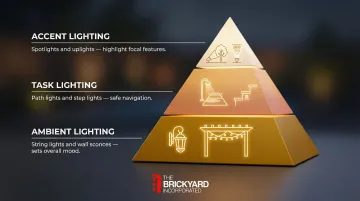
Layer Your Lighting
A well-designed outdoor scheme uses all three layers together:
- Accent lighting: Spotlights and uplights that highlight focal features
- Task lighting: Path lights and step lights for safe navigation
- Ambient lighting: String lights and wall sconces that set the overall mood
Relying on a single layer creates a flat, uninspiring result.
Choose Low-Voltage LED Systems
Once you've mapped your zones and layers, the next step is picking the right system — and for permanent landscape lighting, low-voltage LED is the clear choice. The U.S. Department of Energy confirms that LEDs use 75-90% less energy than incandescent or halogen bulbs, with rated lifespans of 40,000–72,000 hours versus 2,000–5,000 hours for halogen equivalents.
Beyond efficiency, low-voltage systems offer practical advantages that matter as your landscape evolves:
- Run cooler than line-voltage alternatives, reducing fire risk near plants and mulch
- Easier to expand or reconfigure as plantings grow or hardscape changes
- Compatible with smart transformers that allow zone-by-zone dimming and scheduling from a smartphone
Frequently Asked Questions
What are the latest trends in outdoor lighting?
Current trends include smart/app-controlled low-voltage systems, warm-white LED color temperatures (2700K–3000K), and minimalist fixture designs in dark bronze or matte black finishes. Integrated hardscape lighting built directly into paver and retaining wall systems is growing rapidly in popularity.
What type of lighting is best for outdoor landscapes?
Low-voltage LED landscape lighting is the most widely recommended option due to its energy efficiency, longevity, safety (12V system presents no shock risk), and versatility across fixture types including spotlights, path lights, well lights, and hardscape fixtures.
What is the difference between uplighting and downlighting?
Uplighting directs light upward from ground level to illuminate trees, walls, or architectural features from below, creating drama and highlighting texture. Downlighting (including moonlighting) places fixtures high and aims them downward to mimic natural overhead light and create softer, more diffused illumination.
How many lumens do I need for outdoor landscape lighting?
Path lights typically need 100–200 lumens, spotlights for trees or walls need 200–400 lumens, and security/floodlights need 700–1,300 lumens. Layering multiple lower-lumen fixtures produces better results than using fewer very bright ones.
Can I install landscape lighting myself, or do I need a professional?
Low-voltage landscape lighting systems (12V) are DIY-friendly and don't require an electrician. Line-voltage (120V) fixtures typically require a licensed electrician; for complex multi-zone designs or large-area in-ground wiring, a licensed installer handles the work more efficiently and positions fixtures for better coverage.
How do I light a patio or outdoor living space on a budget?
Start with high-impact, lower-cost options: string lights over a seating area, a few strategically placed solar path lights, and one or two spotlights on a key focal point like a tree or architectural feature.
Conclusion
The best outdoor landscape lighting designs combine multiple techniques from this list—layering accent, task, and ambient light across different zones—rather than relying on a single approach. Even small additions like step lights or a single uplight on a specimen tree can make a meaningful difference in how you experience your property after dark.
For Milwaukee-area homeowners and contractors planning a hardscape or outdoor living project, visit The Brickyard at 3352 S. Clement Ave. Low-voltage lighting products, pavers, retaining walls, and masonry materials are all available in one place, so you can compare options, match materials, and leave with everything the project needs.